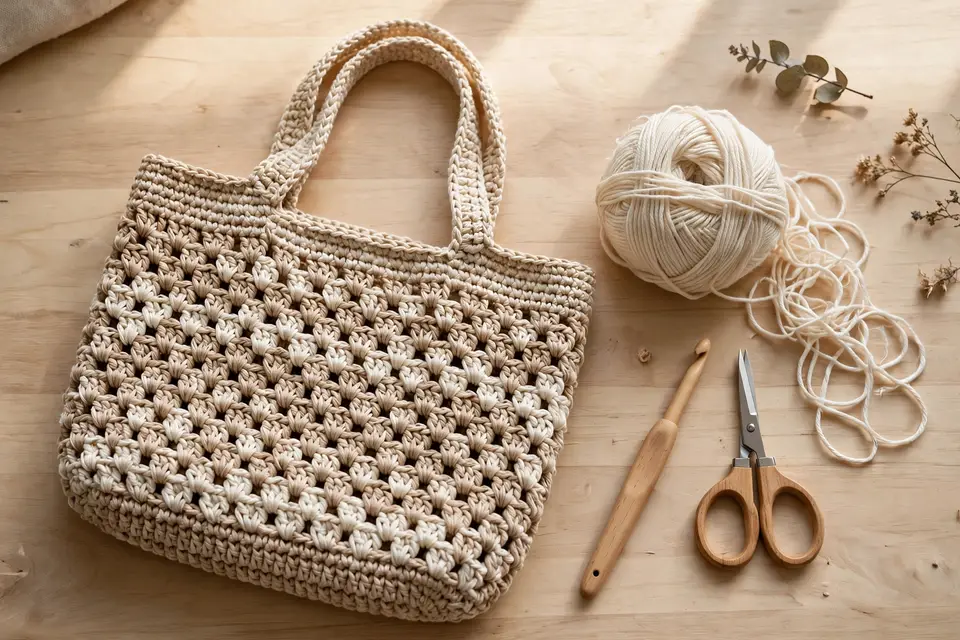
15 Free Crochet Tote Bag Patterns (Plus How to Keep Them Sturdy)
A crochet tote bag should be useful, not just pretty. But many crocheters have the same sad story: they finish a beautiful bag, load it with groceries, and it stretches into a sad, saggy hammock. The handles grow longer every week. Small things slip through the holes.
Good news: that is all avoidable. Below you will find 15 free crochet tote bag patterns, grouped by what you want to use them for. After the patterns, you get a simple guide to making any crochet bag sturdy — the right yarn, handles that do not tear out, and easy ways to add lining.
Quick Picks
| Pattern | Difficulty | Best For |
|---|---|---|
| Simple Solid Tote | Beginner | Your first bag |
| Two-Color Stripe Tote | Beginner | Learning color changes |
| Flat-Bottom Carryall | Beginner | A bag that stands up |
| One-Skein Mini Tote | Beginner | Quick gift |
| Classic Mesh Market Bag | Easy | Groceries |
| Solid-Base Market Tote | Easy | Heavier shopping |
| Drawstring Produce Bags | Easy | Fruit and veggies |
| Fold-Up Shopping Bag | Easy | Keeping in your purse |
| Beach Mesh Tote | Easy | Beach days |
| Raffia-Style Sun Tote | Intermediate | Summer outings |
| Shell-Stitch Day Bag | Easy | A pretty everyday bag |
| Leather-Handle City Tote | Intermediate | Work and errands |
| Reinforced Work Tote | Intermediate | Heavy daily use |
| Granny Square Tote | Easy | Using up scraps |
| Colorful Stripe Beach Bag | Easy | A fun weekend project |
Beginner-Friendly Totes
Start here if this is your first bag. These use simple stitches and have very little seaming.
1. Simple Solid Tote
Work a flat oval base, then crochet straight up in single crochet. That is the whole bag. A smaller hook makes the fabric tight so it does not stretch. Best with: worsted weight cotton and a 4.5 mm hook. Best for: learning bag basics — base, sides, and handles in one project.
2. Two-Color Stripe Tote
Same idea as the simple tote, but you change colors every few rounds. Stripes hide small tension wobbles, which makes this very forgiving for beginners. Best with: two balls of worsted cotton and a 5.0 mm hook. Best for: practicing clean color changes.
3. Flat-Bottom Carryall
This one has a firm rectangular base worked in dense single crochet. The base holds its shape, so the bag stands on its own instead of slumping. Best with: chunky cotton and a 5.5 mm hook. Best for: a bag that sits flat on a table.
4. One-Skein Mini Tote
A small tote you can finish in an evening. It holds a phone, wallet, and keys — perfect for quick errands. Because it is small, stretching is never a problem. Best with: one skein of worsted cotton and a 5.0 mm hook. Best for: a last-minute handmade gift.
New to crochet? Start with the easiest crochet stitches for beginners — the single crochet you learn there builds every bag in this list.
Market and Grocery Totes
Market bags need to hold weight. The patterns below either use mesh (light and stretchy in a good way) or solid fabric with strong bases.
5. Classic Mesh Market Bag
The French-style string bag: an open mesh body that folds down to nothing and stretches to hold a full grocery run. Work the mesh with chains and double crochet. Best with: sport weight cotton and a 4.0 mm hook. Best for: a bag that lives in your purse until you need it.
6. Solid-Base Market Tote
A market bag with a solid crocheted base and mesh sides. The solid base keeps small items from falling out, and the mesh sides keep it light. Best with: worsted cotton and a 5.0 mm hook. Best for: heavier shopping without the saggy-bottom problem.
7. Drawstring Produce Bags
Small mesh bags with a drawstring top for fruit, vegetables, and bulk goods. Make three or four in different sizes. They replace plastic produce bags completely. Best with: lightweight cotton and a 3.5 mm hook. Best for: zero-waste grocery trips.
8. Fold-Up Shopping Bag
A roomy bag that folds into its own little pocket. Keep it in your handbag and you will never need a plastic bag again. Best with: DK weight cotton and a 4.0 mm hook. Best for: everyday errands.
Beach and Summer Totes
Beach bags need to be big, light, and able to shake sand out easily.
9. Beach Mesh Tote
A large, open-mesh tote that holds towels and sunscreen but lets sand fall right through. The mesh also means it dries fast if it gets wet. Best with: worsted cotton in a bright color and a 5.5 mm hook. Best for: your first summer project.
10. Raffia-Style Sun Tote
Raffia or paper yarn makes a firm, structured bag that looks like the expensive beach bags in stores. The stiff fiber holds its shape with no lining needed. Work slowly — raffia can be rough on your hands. Best with: raffia yarn and a 4.5 mm hook. Best for: a polished summer bag.
11. Colorful Stripe Beach Bag
Bold stripes in summer colors, worked in double crochet for speed. This one works up fast and uses a lot of yarn, so it is great for clearing out your stash. Best with: leftover worsted cotton — check these scrap yarn crochet patterns for more stash-busting ideas. Best for: a cheerful weekend project.
Everyday Sturdy Totes
These are built to carry real weight, every day. They use dense stitches, strong handles, and simple linings.
12. Shell-Stitch Day Bag
The shell stitch looks fancy but is easy to memorize. It makes a thick fabric that does not stretch much — ideal for a daily bag. Best with: worsted cotton and a 5.0 mm hook. Best for: a pretty bag that still holds its shape.
13. Leather-Handle City Tote
Crochet a clean, solid body, then attach store-bought leather handles. Ready-made handles look professional and will never stretch. You can find them at any craft store. Best with: worsted cotton, a 4.5 mm hook, and a pair of leather handles. Best for: a bag that looks store-bought (in a good way).
14. Reinforced Work Tote
The heavy-duty option. Dense waistcoat stitch body, a plastic canvas base, and straps that run all the way down the sides and under the base. It carries a laptop, lunch, and water bottle without complaint. Best with: two strands of worsted cotton held together and a 6.0 mm hook. Best for: daily work or school use.
Granny Square and Colorful Totes
15. Granny Square Tote
Join granny squares into a bag body, add a solid base, and crochet the handles. Every bag comes out different depending on your colors. Best with: worsted cotton scraps and a 5.0 mm hook. Best for: using up leftover yarn in the prettiest way possible.
How to Make Your Crochet Tote Sturdy
Pick any pattern above and add these tricks. They are the difference between a bag that lasts a month and a bag that lasts for years.
Use cotton, not acrylic. Cotton yarn barely stretches. Acrylic stretches under weight, which is why so many first bags sag. Mercerized cotton is smooth and strong. T-shirt yarn and raffia are also good for structured bags.
Go down a hook size or two. A smaller hook makes tighter stitches. Tight fabric stretches less. For the base and handles, dense stitches like single crochet or waistcoat stitch work best.
Attach handles to the base, not just the rim. Handles sewn only to the top edge pull free under load. Run the straps down the sides and stitch them through the base fabric. Overlap the strap ends by 5–7 cm and sew a rectangle with an X inside it. Then give it a hard tug before you call it done.
Line your bag. A simple cotton lining keeps small items in and adds structure. Cut fabric slightly smaller than the bag, sew it into a pouch, and stitch it about 1 cm below the rim. Add a pocket while you are at it.
Add a firm base. Cut a piece of plastic canvas slightly smaller than the base and sew it in. The bag will stand on its own and never slump. A flat oval or rectangle base with the right number of increases also stops curling.
Make straps wider and stronger. Work handles at least 3–4 cm wide. Add a slip-stitch edge for firmness, or thread a cotton cord through a tube-style strap for extra strength.
Stiffen a floppy finished bag. If a bag is already done and too soft, brush it with a starch solution or diluted PVA glue, reshape it by hand, and let it air dry. It will hold the new shape.
FAQ
Why does my crochet bag stretch out?
Loose stitches and stretchy yarn are the usual cause. Acrylic yarn stretches under weight, and open stitch patterns expand when loaded. Use cotton yarn, a smaller hook, and dense stitches for the base and handles.
How do I stop the handles from tearing off?
Anchor them deep. Run straps down the sides of the bag and stitch them through the base, not just the top rim. Overlap the ends and sew a rectangle with an X. A tug test before finishing saves heartbreak later.
Should I line my crochet tote bag?
Yes, if you carry small things or want structure. A cotton lining stops keys and coins from slipping through stitches and makes the bag feel finished. Sew it about 1 cm below the rim.
What is the best yarn for crochet tote bags?
Worsted weight cotton is the best all-rounder — strong, low-stretch, and washable. T-shirt yarn makes chunky, structured bags. Raffia is great for firm summer bags. Avoid 100% acrylic for bags that carry weight.
How do I make a crochet bag stand up on its own?
Work a flat, firm base with correct increases, and sew a piece of plastic canvas inside the base. Dense stitches and a smaller hook help too.
Can beginners crochet a tote bag?
Absolutely. A simple single-crochet tote is one of the best first projects — it is just a base plus straight sides. Start with pattern 1 or 3 above.
How do I keep things from falling through a mesh market bag?
Keep the mesh openings small (under 2 cm), or add a fabric lining to a mesh bag. A solid crocheted base also stops small items from escaping.
Why is the top edge of my bag wavy?
Too many stitches around the opening cause ruffling. Work one or two rounds of single crochet with slight decreases around the rim to pull it in neatly.
How do I wash a crochet tote bag?
Hand wash in cold water with mild soap, then lay flat to dry and reshape it while damp. Never use a hot dryer — heat can shrink cotton and warp the shape.
Can I sell crochet tote bags I make from free patterns?
Most free patterns allow selling finished items, but always check the designer’s terms. Many ask only for credit when you list the bag for sale.